PhoolBazar
Role
UX/UI Designer
Date
2025
Timeline
3 weeks
Location
Jamalpur Flower Market, Ahmedabad
Team
Individual
Connecting flower waste to a more sustainable lifecycle
OVERVIEW
TASK
PROCESS
RESULT
PROBLEM
SOLUTION
CHALLENGES
REFELECTION



Figure 1.1
Figure 2.1
Figure 3.1.1
Figure 3.2.1
Figure 3.1.2
Figure 2.2
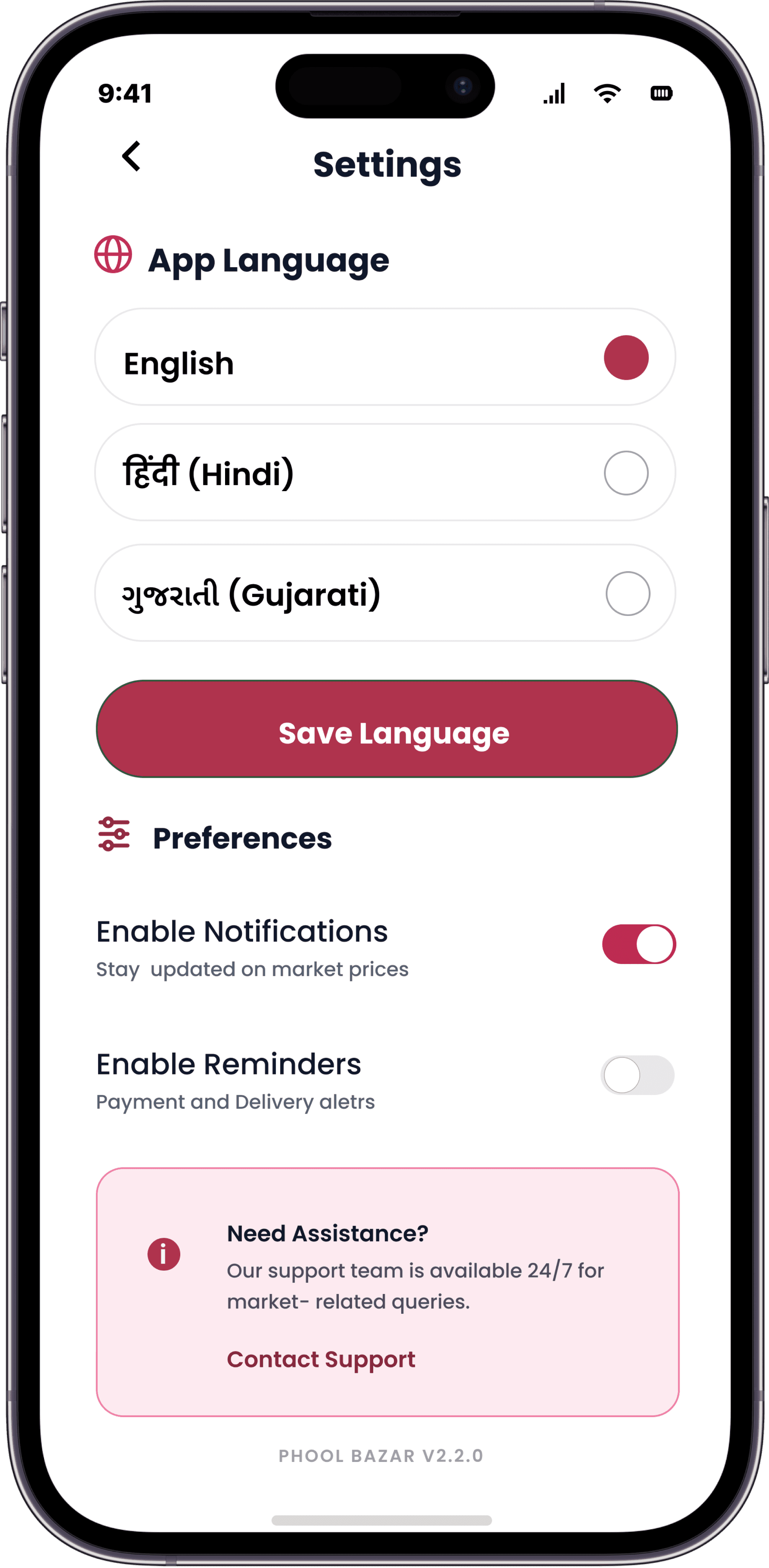
Settings & Language Preferences
Switch between English, Hindi, and Gujarati while managing notifications and reminder preferences.
Dashboard Overview
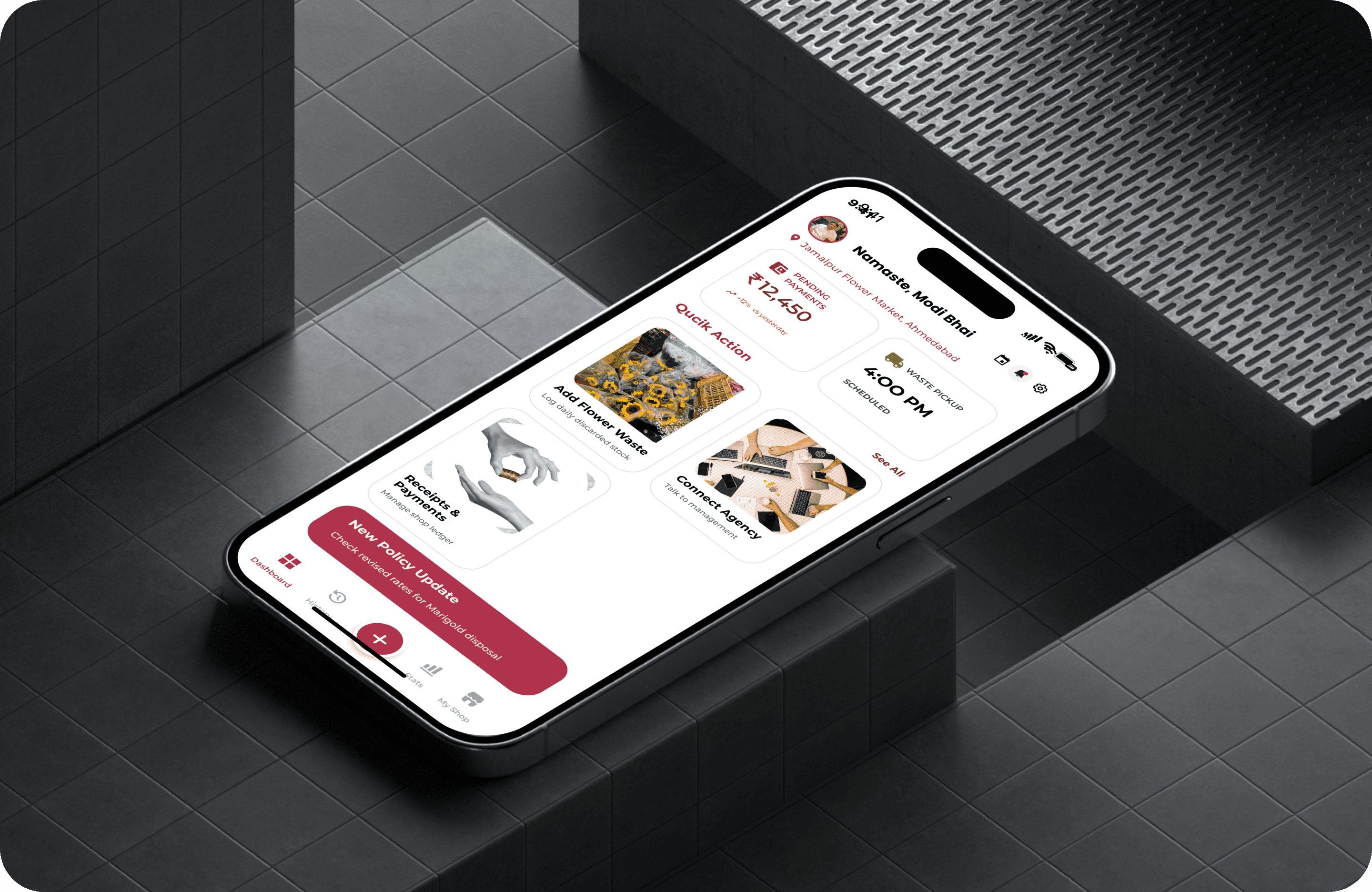
A centralized hub showing daily shop insights, pending payments, waste pickup schedules, and quick actions.
Calendar & Order Tracking
Track upcoming pickups, deliveries, and customer orders through a simple calendar view.
Agency Details
View agency services, accepted flower types, and response time before connecting.


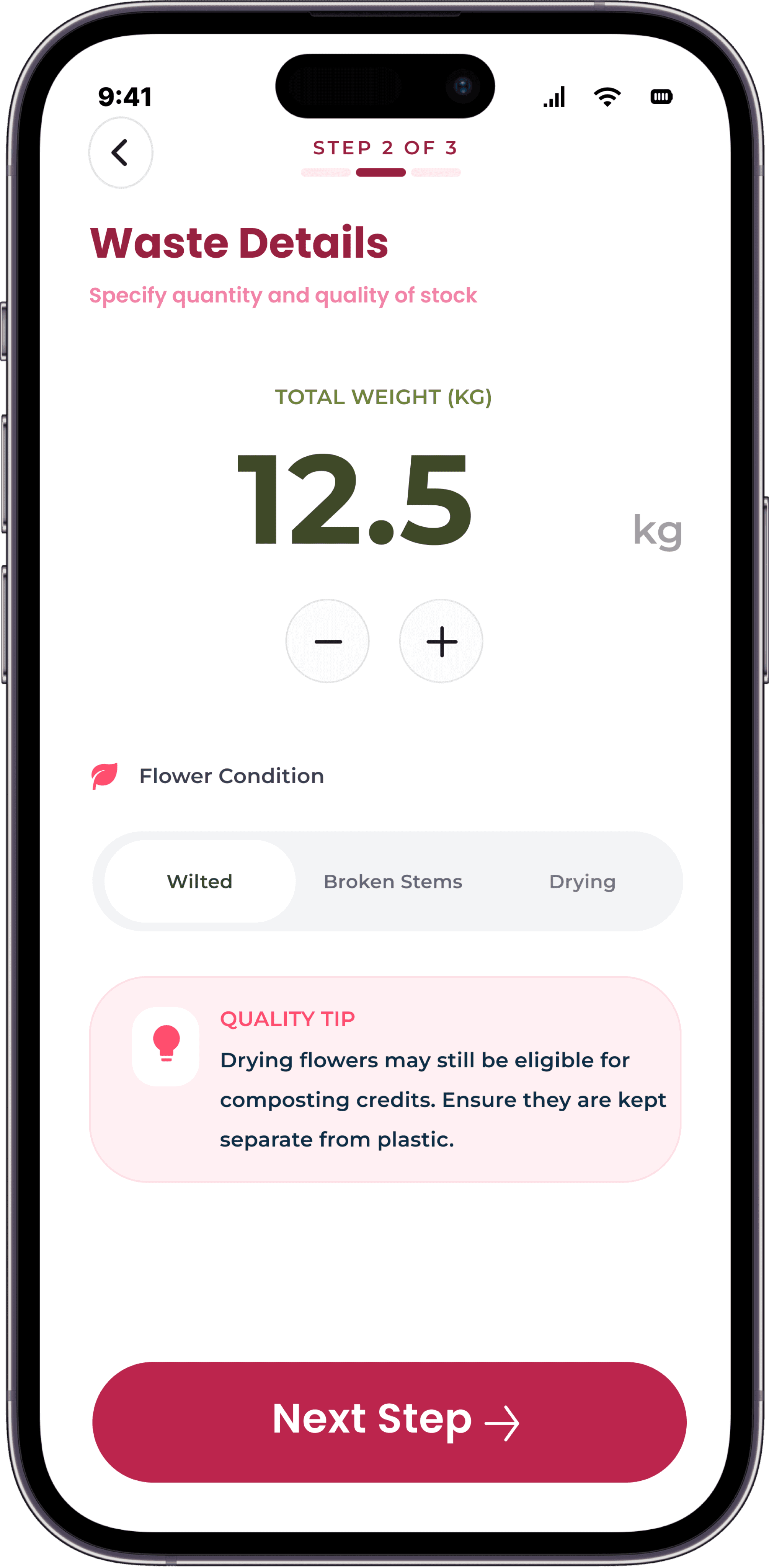
Waste Details
Enter the quantity and condition of the flowers to accurately track unsold stock.
Dashboard Overview
Access daily shop insights and quick actions like waste logging, agency connections, and payment tracking.
Select Flower Waste
Choose the type of unsold flowers to log and begin the waste recording process.


Choose Disposal Method
Select the preferred disposal option such as recycling, composting, or municipal pickup.
Waste History
Review previously logged waste records and track disposal activities over time.

Create Receipt
Record customer orders, payment status, and pickup details to maintain a clear shop ledger.
Transaction Details
View complete order information including items, total amount, and payment status.
Send Payment Reminder
Send a quick WhatsApp reminder to customers for pending payments directly from the app.
Overview
Phool Bazar is a mobile app designed to simplify the everyday operations of flower-market shop owners at Jamalpur Flower Market, Ahmedabad.
Through field research, I found that vendors manage important tasks such as flower waste, payments, customer orders, and pickups through memory, handwritten khata records, and informal workflows.
Phool Bazar brings these tasks into one simple system — helping vendors log unsold flowers, connect with recycling agencies, track payments, manage orders, and receive reminders without forcing them to change the way they already work.
Task
Understand the everyday challenges faced by flower market vendors and design a simple digital system that supports their existing way of working.
The project focused on understanding how vendors manage flowers, payments, customers, and waste in their daily routines, and identifying opportunities where technology could reduce mental effort without adding complexity.
The goal was to create a lightweight mobile experience that helps vendors:
Manage unsold flower waste
Track payments and pending dues
Remember customer pickups
Connect with recycling and composting agencies
Organize daily shop operations

Process
Research
Primary Research ( Understanding the people behind the market )
I conducted primary research at Jamalpur Flower Market, Ahmedabad, to understand how flower vendors manage their daily work.
The research used contextual inquiry, informal interviews, shadowing, and photo documentation to observe real workflows in the market rather than relying only on assumptions.
I spoke with flower shop owners and observed how they manage orders, payments, flower stock, customers, and unsold waste during their daily operations.
Methods
Contextual inquiry
Informal interviews
Workflow observation
Photo documentation
Participants
4–6 flower shop owners
Age: 25–55
5+ years of experience in flower selling
What I observed
Vendors rely heavily on memory to track orders and payments.
Unsold flowers are often discarded without a structured waste system.
Payments are recorded in notebooks or remembered mentally.
Vendors have no direct connection with recycling agencies.
Peak hours create significant mental and operational pressure.

Secondary Research ( Understanding the larger waste ecosystem )
Secondary research helped me understand the wider context around floral waste, informal markets and existing digital tools.
I looked at:
Floral waste management in India
Informal market systems
Waste-to-product initiatives such as incense making
Existing payment and reminder tools for small vendors
Key findings
Floral waste can become an environmental problem when unmanaged.
Recycling agencies exist but are not directly connected to vendors.
Small vendors prefer simple, low-effort digital tools.
Complex applications are less suitable for informal market environments.

Personas
Who I Was Designing For
The research revealed three key user groups within the flower-market ecosystem: shop owners, small outside vendors, and customers.
The primary focus became the flower shop owner, who manages multiple responsibilities simultaneously from purchasing flowers and setting prices to tracking payments and handling unsold stock.
-shop owner

Ramesh Modi
SHOP OWNER
Ramesh bhai is a second-generation flower shop owner at Jamalpur Flower Market with over 20 years of experience. His day revolves around purchasing flowers in bulk, managing customers, and handling payments manually. He keeps records in a khata notebook and relies on memory for customer pickups and dues. Unsold flowers at the end of the day often lead to financial loss. While he uses WhatsApp and UPI, he has never used a structured digital tool for managing his shop.
About
Goals
Maintain loyal customer relationships
Earn stable daily income
Reduce financial loss due to flower waste
Expand shop or open another branch
Technology Usage
Uses smartphone regularly
Comfortable with calls, WhatsApp, and UPI
Limited experience with structured digital systems
Pain Points
Price fluctuation creates uncertainty
Difficulty tracking pending payments
High mental load during peak hours
Lack of structured waste management system
Storage space limitations
“The goal is not to change how vendors work , but to support how they already work. “
Age
42 years
Gender
Male
Experience
20+ years n flower trade
Education
Basic to moderate
Business Type
Wholesale + Retail stall
Location
Jamalpur Flower Market ,
Ahmedabad
Empathy Mapping
Finding the Friction
Mapping what vendors say, think, feel, and see helped reveal that many of their problems were not caused by a lack of effort but by the amount of information they had to remember and manage manually.
Their daily workflow involved changing prices, customer payments, unsold flowers, pickup timings, and business decisions, often without a structured system.

Information Architecture
Structuring the Experience
Based on the research, I organized the app around the vendor's most frequent operational needs rather than traditional app categories.
The information architecture prioritizes three core activities: managing flower waste, tracking payments, and remembering customer orders and pickups.
These flows are supported by agency connections, history, reports, reminders, and settings.
01
Onboarding
• Splash screen
– Get started
• Login / owner details
– Owner name input
– Shop name input
– Phone number input
– Continue CTA
• Entry to dashboard
02
Dashboard
• Header section
– Greeting (owner name)
– Shop name
– Location (Jamalpur market)
• Daily summary card
– Pending payments
– Waste pickup status
– Pending deliveries
• Quick actions
– Add flower waste
– Connect agency
– Receipts & payments
– Trackers & reports
• Market updates
– Price / demand insights
• Bottom navigation
– Dashboard
– History
– Add (+)
– Stats
– My shop
03
Waste management flow
• Waste entry
– Step 1 · Select flower type
– Step 2 · Enter quantity
– Step 3 · Waste action choice
• Waste action choice
– Recycle via agency
– Compost
– Municipal pickup
• Confirm action CTA
• Success screen
– Back to dashboard
06
Reminder system
• Set reminder
– Pickup date
– Pickup time
– Save reminder
• Reminder confirmation screen
– Reminder scheduled successfully
• Reminder notification alert
– Order pickup reminder
– Payment due reminder
• Quick action from notification
– Open order
– Send WhatsApp reminder
05
Receipts & payments
• Financial ledger overview
– Total revenue
– Total pending
– Daily transaction summary
• Payment history
– Search customer / order ID
– Paid records
– Pending records
• Receipt detail screen
– Customer name
– Phone number
– Order details
– Payment status toggle
– Mark as paid CTA
04
Agency connection flow
• Agency directory
– Incense recycling agencies
– Compost agencies
– NGOs
– Municipal waste partner
• Agency detail screen
– Agency name & info
– Accepted flower types
– Response time
– Rating
– About agency
• Action
– Call agency
– Request pickup
• Request sent screen
– Confirmation message
– Estimated arrival time
• Incoming connection request
– Accept request
– Decline request
• Partnership confirmation
– Start first pickup
– View my partners
Results
Research findings revealed six key patterns that shaped the design direction of Phool Bazar.
88%
Vendors rely on memory and handwritten khata systems.
81%
Payment tracking and credit management is inconsistent.
84%
Unsold flowers directly result in financial loss.
75%
Vendors are comfortable with basic smartphone tools only.
83%
Peak-hour workload creates high mental pressure.
78%
Vendors are open to sustainable practices when they provide value.
Problem
Flower market vendors manage critical parts of their business through memory, handwritten records, and informal workflows.
At Jamalpur Flower Market, vendors simultaneously manage changing prices, customer orders, payments, flower stock, and unsold flowers.
During busy hours, this creates cognitive and operational pressure. Payments are recorded manually, customer pickups depend on memory, and unsold flowers are often discarded without a structured way to recover their value.
The challenge was therefore not to replace the existing workflow, but to support it with a system that feels simple, familiar, and useful.
Manual Tracking
Payments, orders and customer pickups are often remembered or recorded in notebooks.
Flower Waste
Unsold flowers become financial loss because there is no structured waste-recovery system.
Mental Load
Managing customers, prices, payments and stock simultaneously creates pressure during peak hours.
Solution
A lightweight mobile tool that supports vendors in managing waste, payments, and daily operations without disrupting how they already work.
Solution 01 — Dashboard
One place to run the shop
The dashboard brings daily shop activity into one place, giving vendors quick access to pending payments, waste pickup status, deliveries, and key actions.
Quick-action cards reduce the number of steps needed during busy market hours.


Solution 02 — Waste Management
Turn unsold flowers into an actionable task
Instead of leaving unsold flowers as an end-of-day problem, Phool Bazar allows vendors to record their waste, choose the flower type and quantity, and select what happens next.
Vendors can choose between recycling, composting, or municipal pickup, turning waste management into a simple, structured workflow.
Solution 03 — Agency Connection
Connect vendors with waste partners
Vendors can discover recycling and composting partners, view agency information, and request pickups directly through the app.
The flow creates a bridge between flower vendors and organizations that can give unsold flowers a second life.

Agency Directory
Browse verified recycling and composting partners with trust scores and quick filters.
Pickup Request Sent
Request confirmed with estimated arrival time and pickup details.
Solution 04 — Payments
Replace the notebook with a clearer ledger
Phool Bazar organizes daily transactions, pending payments, and completed receipts into a digital ledger.
By making outstanding dues and transaction history visible, the system reduces dependence on handwritten khata records and gives vendors greater financial clarity.
Solution 05 — Reminder
Remember it without having to remember
Vendors can create receipts while setting pickup reminders, and receive notifications for upcoming customer pickups and pending payments.
Combining these actions helps reduce missed pickups and unnecessary payment follow-ups.
Challenges
01 — Designing for Informal Workflows
The biggest challenge was designing a digital system without forcing vendors to abandon the informal methods they already rely on.
The solution therefore had to support existing habits rather than replace them.
02 — Keeping the Experience Simple
Vendors are comfortable with everyday tools such as calls, WhatsApp, and UPI, but complex digital systems can become difficult to adopt.
This pushed the design toward fewer steps, clear actions, visual hierarchy, and familiar interactions.
03 — Balancing Multiple Needs
The app needed to bring together waste management, payments, customer orders, reminders, and agency connections without making the experience feel overwhelming.
Reflections
What I learned
This project taught me that good UX for informal environments is not about introducing technology for the sake of technology. It is about understanding existing behaviors and designing around them.
The research showed me that vendors already have efficient ways of working, but those workflows rely heavily on memory, trust, and manual records. My role as a designer was to identify where digital support could reduce mental effort without disrupting those familiar patterns.
I also learned the importance of designing for simplicity. For users who are not accustomed to structured digital systems, reducing unnecessary steps can be more valuable than adding more features.
What I would improve
If I continued the project, I would validate the prototype with a larger group of flower vendors and observe how they use the product during real peak-hour conditions.
I would also test the waste-management and agency-connection flows in the actual market environment to understand whether the proposed system fits naturally into vendors' existing routines.


08
History & reports
• Waste logs
– Daily waste quantity
– Disposal method used
• Payment reports
– Daily earning
– Pending amount
– Collection trends
• Agency interaction logs
09
Agency interaction history
• Interaction timeline
– Today
– Yesterday
– Previous records
• Interaction cards
– Agency name
– Pickup status
– Call again button
– Notes / status tag
• Log new interaction
10
Settings
• Language setting
– English
– Hindi
– Gujarati
• Preferences
– Enable notifications
– Enable reminders
– WhatsApp integration
• Support & help
– Contact support
– FAQs
07
Calendar & order tracking
• Monthly calendar view
– Today orders
– Upcoming orders
– Completed orders
• Daily order detail
– Customer name
– Order type
– Pickup / delivery time
– Status
• Quick action
– Call customer
– Mark completed
– Edit order
Thanks for Reading
Handicrafts of Gujarat


PhoolSetu (Small Flower Vendor)
