
Handicrafts of Gujarat
Handicrafts of Gujarat
Handicrafts of Gujarat
Bringing Gujarat’s Craft Heritage to the Digital World
Bringing Gujarat’s Craft Heritage to the Digital World
Bringing Gujarat’s Craft Heritage to the Digital World
Role
Role
Role
UX/UI Designer
UX/UI Designer
UX/UI Designer
Project
Project
Project
Information Design
Information Design
Information Design
Tools
Tools
Tools
Figma · Figma Make
Figma · Figma Make
Figma · Figma Make
Duration
Duration
Duration
3 Weeks
3 Weeks
3 Weeks
Team
Team
Team
Individual
Individual
Individual
Overview
Overview
Overview
Handicrafts of Gujarat is a cultural storytelling platform designed to digitally showcase Gujarat’s rich handicraft heritage through contemporary UI/UX design, interactive narratives, and editorial-inspired visual systems.
The project explores the relationship between traditional crafts, artisan communities, regional identities, and the wider craft ecosystem. It transforms craft-related research into a structured digital experience using visual storytelling, cultural exploration, and data visualizations.

Figure 1.1
Task
Task
Task
The task was to transform traditional handicraft documentation into an engaging digital storytelling experience that helps users explore Gujarat’s craft heritage.
The task was to transform traditional handicraft documentation into an engaging digital storytelling experience that helps users explore Gujarat’s craft heritage.
The task was to transform traditional handicraft documentation into an engaging digital storytelling experience that helps users explore Gujarat’s craft heritage.
The project focused on:
- Presenting craft information through a clear visual hierarchy.
- Structuring information about crafts and their regional distribution.
- Connecting craft traditions with artisan communities.
- Exploring local and export-market relationships.
- Using interactive storytelling and data visualization to make the information easier to explore.
Process
Process
Process
4.1 Research
4.1 Research
4.1 Research
Research Overview
My research focused on Gujarat’s craft traditions, artisan communities, regional craft clusters, and cultural archives. I also explored digital storytelling and editorial websites to understand how cultural information could be presented through an engaging online experience.
Research Overview
My research focused on Gujarat’s craft traditions, artisan communities, regional craft clusters, and cultural archives. I also explored digital storytelling and editorial websites to understand how cultural information could be presented through an engaging online experience.
Research Overview
My research focused on Gujarat’s craft traditions, artisan communities, regional craft clusters, and cultural archives. I also explored digital storytelling and editorial websites to understand how cultural information could be presented through an engaging online experience.


4.2 Key Insights
4.2 Key Insights
4.2 Key Insights
The project’s research and exploration highlighted several themes that shaped the design direction:
The project’s research and exploration highlighted several themes that shaped the design direction:
The project’s research and exploration highlighted several themes that shaped the design direction:
01 — Craft is more than information
01 — Craft is more than information
01 — Craft is more than information
Handicrafts are connected to identity, memory, and tradition. The experience therefore needed to communicate more than factual descriptions alone.
Handicrafts are connected to identity, memory, and tradition. The experience therefore needed to communicate more than factual descriptions alone.
Handicrafts are connected to identity, memory, and tradition. The experience therefore needed to communicate more than factual descriptions alone.
02 — Visual storytelling can support exploration
02 — Visual storytelling can support exploration
02 — Visual storytelling can support exploration
Narrative-based layouts, imagery, and interaction offered a way to present cultural information in a more engaging format.
Narrative-based layouts, imagery, and interaction offered a way to present cultural information in a more engaging format.
Narrative-based layouts, imagery, and interaction offered a way to present cultural information in a more engaging format.
03 — Regional identity matters
03 — Regional identity matters
03 — Regional identity matters
Different regions have distinct craft traditions and visual identities. The design needed to make regional exploration an important part of the experience.
Different regions have distinct craft traditions and visual identities. The design needed to make regional exploration an important part of the experience.
Different regions have distinct craft traditions and visual identities. The design needed to make regional exploration an important part of the experience.
04 — Craft traditions are interconnected
04 — Craft traditions are interconnected
04 — Craft traditions are interconnected
Crafts exist within broader networks of artisans, villages, markets, exports, and inherited knowledge.
Crafts exist within broader networks of artisans, villages, markets, exports, and inherited knowledge.
Crafts exist within broader networks of artisans, villages, markets, exports, and inherited knowledge.
05 — Interaction can make complex information easier to explore
05 — Interaction can make complex information easier to explore
05 — Interaction can make complex information easier to explore
The project explored motion, interaction, and editorial composition as ways to encourage curiosity and support information engagement.
The project explored motion, interaction, and editorial composition as ways to encourage curiosity and support information engagement.
The project explored motion, interaction, and editorial composition as ways to encourage curiosity and support information engagement.
4.3 Problem Statement
4.3 Problem Statement
4.3 Problem Statement
Gujarat’s handicrafts represent a rich cultural heritage, but traditional documentation can be difficult to explore when it is presented through static, text-heavy, or visually outdated formats.
The project identified opportunities to improve how users discover craft traditions, understand regional and market relationships, and connect with the stories behind the crafts.
Design Opportunities
Design Opportunities
Design Opportunities
Make craft information easier to discover.
Introduce more engaging cultural storytelling.
Help users explore craft regions and communities.
Present local and export-market information visually.
Create a contemporary interface that respects the cultural subject matter.
Make craft information easier to discover.
Introduce more engaging cultural storytelling.
Help users explore craft regions and communities.
Present local and export-market information visually.
Create a contemporary interface that respects the cultural subject matter.
Make craft information easier to discover.
Introduce more engaging cultural storytelling.
Help users explore craft regions and communities.
Present local and export-market information visually.
Create a contemporary interface that respects the cultural subject matter.
4.5 User Flow
4.5 User Flow
4.5 User Flow
Structuring the Experience
Structuring the Experience
Structuring the Experience
The user flow organizes the experience into a sequence that begins with an introduction to Gujarat’s handicrafts and continues through craft exploration, historical context, regional information, and livelihood-related insights.
The user flow organizes the experience into a sequence that begins with an introduction to Gujarat’s handicrafts and continues through craft exploration, historical context, regional information, and livelihood-related insights.
The user flow organizes the experience into a sequence that begins with an introduction to Gujarat’s handicrafts and continues through craft exploration, historical context, regional information, and livelihood-related insights.
The flow includes:
The flow includes:
The flow includes:
Hero section
Introduction to Gujarat handicrafts
Interactive craft cards
Historical timeline
Regional craft exploration
Local versus export-market visualization
Livelihood and gender insights
Behind the craft / methodology
Final reflection
Hero section
Introduction to Gujarat handicrafts
Interactive craft cards
Historical timeline
Regional craft exploration
Local versus export-market visualization
Livelihood and gender insights
Behind the craft / methodology
Final reflection
Hero section
Introduction to Gujarat handicrafts
Interactive craft cards
Historical timeline
Regional craft exploration
Local versus export-market visualization
Livelihood and gender insights
Behind the craft / methodology
Final reflection

4.6 Visual Direction — Typography & Colour
4.6 Visual Direction — Typography & Colour
4.6 Visual Direction — Typography & Colour
Creating the Visual Language
Creating the Visual Language
Creating the Visual Language
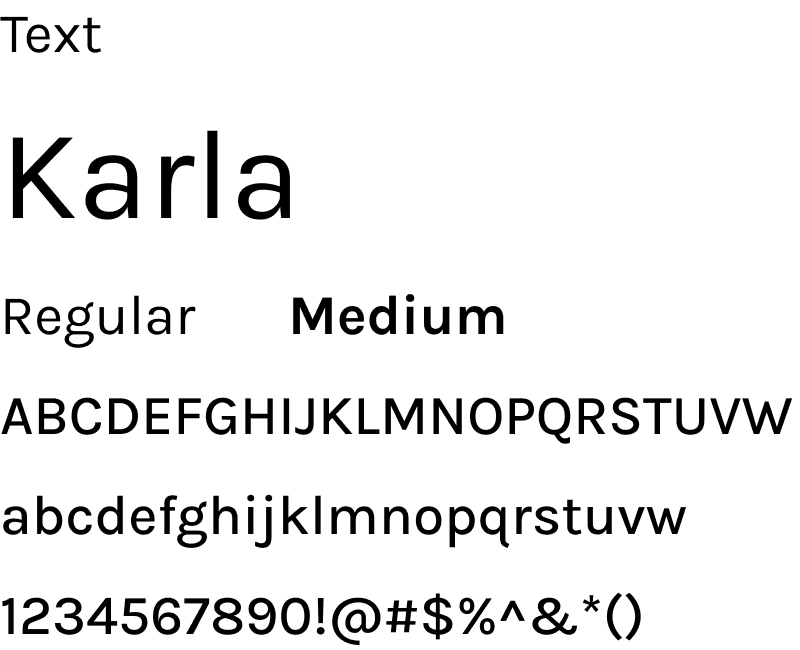
The visual direction combines a contemporary interface with an editorial style inspired by cultural archives and handcrafted heritage.
The typography and colour palette were selected to create a minimal, elegant identity while reflecting the project’s cultural subject matter.
The visual direction combines a contemporary interface with an editorial style inspired by cultural archives and handcrafted heritage.
The typography and colour palette were selected to create a minimal, elegant identity while reflecting the project’s cultural subject matter.
The visual direction combines a contemporary interface with an editorial style inspired by cultural archives and handcrafted heritage.
The typography and colour palette were selected to create a minimal, elegant identity while reflecting the project’s cultural subject matter.

Dark Red
#AF1C20
Dark Red
#AF1C20
Dark Blue
#32365F
Dark Blue
#32365F
Dark Orange
#E18C18
Dark Orange
#E18C18
Off - White
#F2F3ED
Off - White
#F2F3ED
Design Solution
Design Solution
Design Solution
5.1 Landing Page
5.1 Landing Page
5.1 Landing Page
Introducing the Craft Heritage
The landing page introduces Gujarat’s handicraft heritage through large serif typography, layered imagery, and an editorial composition.
The visual approach uses a museum-like hierarchy to introduce the subject and invite users into the cultural storytelling experience.

Home Page
5.2 Introduction Section
5.2 Introduction Section
5.2 Introduction Section
Establishing the Cultural Context
The introduction presents Gujarat’s handicrafts as a living cultural system shaped by materials, regional identity, community practices, and generations of artisan knowledge.
It provides context for the craft traditions explored throughout the experience.
Establishing the Cultural Context
The introduction presents Gujarat’s handicrafts as a living cultural system shaped by materials, regional identity, community practices, and generations of artisan knowledge.
It provides context for the craft traditions explored throughout the experience.
Establishing the Cultural Context
The introduction presents Gujarat’s handicrafts as a living cultural system shaped by materials, regional identity, community practices, and generations of artisan knowledge.
It provides context for the craft traditions explored throughout the experience.

Introduction page
5.3 Historical Timeline
5.3 Historical Timeline
5.3 Historical Timeline
Exploring the Evolution of Craft
The timeline presents the evolution of Gujarat’s handicrafts through different historical periods, from early craft traditions to modern adaptation.
Archival imagery and handcrafted illustrations support the historical narrative and connect past traditions with the digital experience.

Historical Timeline
5.4 Regional Craft Exploration
5.4 Regional Craft Exploration
5.4 Regional Craft Exploration
Discovering Crafts by Region
The regional exploration section organizes craft information geographically, helping users explore traditions associated with different parts of Gujarat.
The design uses regional navigation and craft-related information to connect places, communities, and techniques within a unified experience.

Historical Timeline
5.5 Craft Ecosystem & Data Visualization
5.5 Craft Ecosystem & Data Visualization
5.5 Craft Ecosystem & Data Visualization
Making Relationships Visible
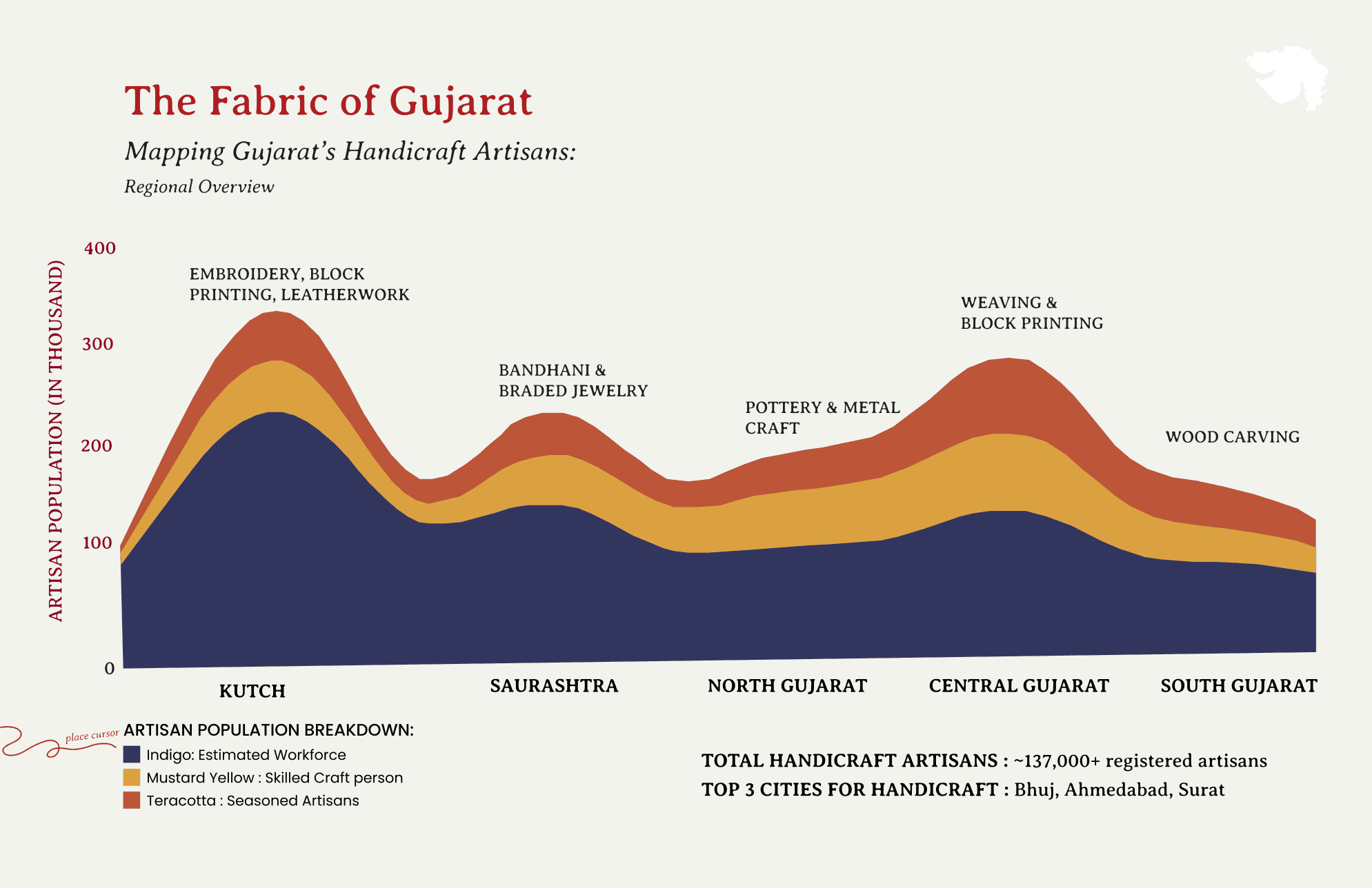
The project uses data visualization to explore the relationships between regional craft identities, artisan communities, livelihoods, and market systems.
The visualizations include regional craft information, artisan-related data, income analysis, and comparisons between local and export markets.
Historical Timeline
5.6 Gender Participation
5.6 Gender Participation
5.6 Gender Participation
Making Relationships Visible
This section presents gender participation across selected handicraft sectors in Gujarat.
The visualization compares participation patterns across craft categories and uses contrasting visual elements and structured layouts to communicate the information.
Making Relationships Visible
This section presents gender participation across selected handicraft sectors in Gujarat.
The visualization compares participation patterns across craft categories and uses contrasting visual elements and structured layouts to communicate the information.
Making Relationships Visible
This section presents gender participation across selected handicraft sectors in Gujarat.
The visualization compares participation patterns across craft categories and uses contrasting visual elements and structured layouts to communicate the information.

Gender Participation
5.7 Behind the Craft / Methodology
5.7 Behind the Craft / Methodology
5.7 Behind the Craft / Methodology
Connecting Research with the Experience
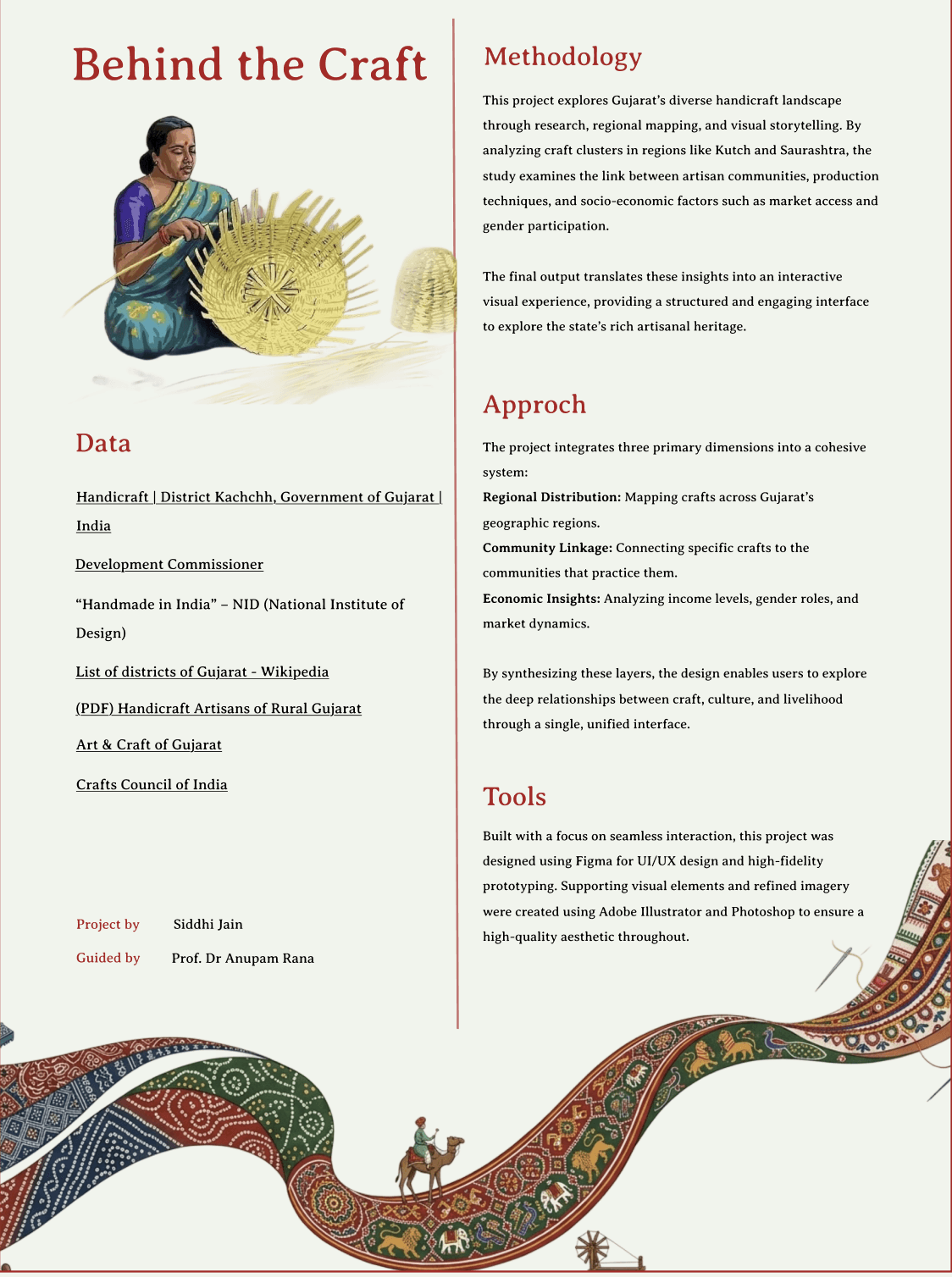
The project brings together research into craft regions, artisan communities, production techniques, and socio-economic factors such as market access and gender participation.
The resulting interface combines these dimensions through regional exploration, community connections, and economic insights.
Website Link - https://handicraftsofgujarat.figma.site/
Website Link - https://handicraftsofgujarat.figma.site/
Website Link - https://handicraftsofgujarat.figma.site/
Result / Design Outcome
Result / Design Outcome
Result / Design Outcome
The project translates research about Gujarat’s handicraft heritage into a digital storytelling experience using contemporary UI/UX design, editorial layouts, and interactive information structures.
The project translates research about Gujarat’s handicraft heritage into a digital storytelling experience using contemporary UI/UX design, editorial layouts, and interactive information structures.
The project translates research about Gujarat’s handicraft heritage into a digital storytelling experience using contemporary UI/UX design, editorial layouts, and interactive information structures.
The final design explores how cultural information can be organized and presented through:
- Immersive storytelling.
- A distinct editorial visual identity.
- Structured craft and regional exploration.
- Data visualizations for craft-related information.
- A combination of cultural context and contemporary interface design.

Challenges
Challenges
Challenges
The project translates research about Gujarat’s handicraft heritage into a digital storytelling experience using contemporary UI/UX design, editorial layouts, and interactive information structures.
The project translates research about Gujarat’s handicraft heritage into a digital storytelling experience using contemporary UI/UX design, editorial layouts, and interactive information structures.
The project translates research about Gujarat’s handicraft heritage into a digital storytelling experience using contemporary UI/UX design, editorial layouts, and interactive information structures.
Organizing complex information
The project brings together craft traditions, regional distribution, communities, and economic information.
Structuring these different topics into a coherent experience was an important part of the design.
Balancing editorial aesthetics with clarity
The interface needed to combine an expressive visual direction with readable and accessible information structures.
Representing cultural identity thoughtfully
The visual storytelling approach needed to support the heritage and regional identity of the crafts being presented.
Making data easier to explore
The project explored visualizations and structured layouts to communicate relationships across craft regions, communities, and markets.
Reflection
Reflection
Reflection
Through this project, I developed a deeper understanding of how information design can transform complex cultural material into a more engaging digital experience.
I learned the importance of organizing large amounts of information, establishing a clear visual hierarchy, and using editorial storytelling and interaction to structure an experience.
The project also helped me explore how to balance aesthetics with clarity, structure large informational systems, consider the role of motion in storytelling, and approach cultural design with sensitivity and authenticity.
Full Case Study
Full Case Study
Full Case Study

available for : ux/ui internships & full time
available for : ux/ui internships & full time
based in : ahmedabad, india
based in : ahmedabad, india
email : siddhijain.design@gmail.com
email : siddhijain.design@gmail.com